1518年跳舞瘟疫:斯特拉斯堡数百人停不下来地跳舞
 Detetive Curioso
··3 分钟阅读·历史·76 次浏览
1518年夏天,一名女子在斯特拉斯堡街头开始跳舞,一连数天没有停下。几周之内,数百人加入了她。
本文尚未翻译。
In July 1518, in the city of Strasbourg, then part of the Holy Roman Empire and today in France, a woman stepped into a narrow street and began to dance. Most chronicles call her Frau Troffea. There was no music and no celebration. She danced until she collapsed, rested, and then started again, for several days in a row.
Within about a week, more than 30 people had joined her. By the end of August, according to one chronicler, as many as 400 people had been seized by the same compulsion. Witnesses described dancers with bloodied feet, convulsing and crying out for help, unable to stop even when they were exhausted.
What makes the episode remarkable is how well it is documented. Historians can follow it through city council records, sermons, local chronicles and the writings of the Renaissance physician Paracelsus. The historian John Waller, who has studied the event in detail, notes that while some earlier medieval dancing outbreaks may be legend, there is no doubt that this one happened. It is the line between history and folklore, the same one a museum of legendary creatures in Texas loves to blur.
The city's response made things worse. Local physicians ruled out astrological and supernatural causes and declared it a natural disease caused by "hot blood". The cure they prescribed was more dancing. The authorities cleared two guildhalls and the grain market, built a wooden stage, and paid musicians and strong professional dancers to keep the afflicted moving day and night. Turning the dancing into a public spectacle probably only spread it further. Strange prescriptions survived the centuries: in the 1830s, Americans swallowed tomato pills sold as a cure for almost everything.
Eventually the council changed course. It banned public music and dancing, and the dancers were taken to a shrine dedicated to Saint Vitus in the hills near Saverne, where, in a ritual meant to lift the curse, they were given small crosses and red shoes. By September the outbreak had faded.
Did people die? A later chronicle claims that at one point about 15 people a day were dying, but that figure does not appear in the city records of the time, and historians still disagree about whether anyone died at all.
As for the cause, one old theory blamed ergot, a fungus that grows on rye and can cause convulsions and hallucinations. Many historians find that unlikely, because ergot poisoning restricts blood flow to the limbs and would make days of coordinated dancing very hard. The explanation favored by Waller is mass psychogenic illness: a reaction to extreme stress that spreads through a community. Strasbourg in 1518 was suffering from famine, diseases such as smallpox and syphilis, and widespread hardship, and many people believed that Saint Vitus could punish sinners by forcing them to dance. In that setting, Waller argues, fear and belief could turn into a physical epidemic.
Strasbourg was not the only case. Similar outbreaks were recorded along the Rhine and in the Low Countries in 1374. But 1518 remains the best documented example of one of history's strangest episodes, a time when dancing was treated as both the disease and the cure. Four centuries later, Boston would add its own chapter to that list with the Great Molasses Flood of 1919.
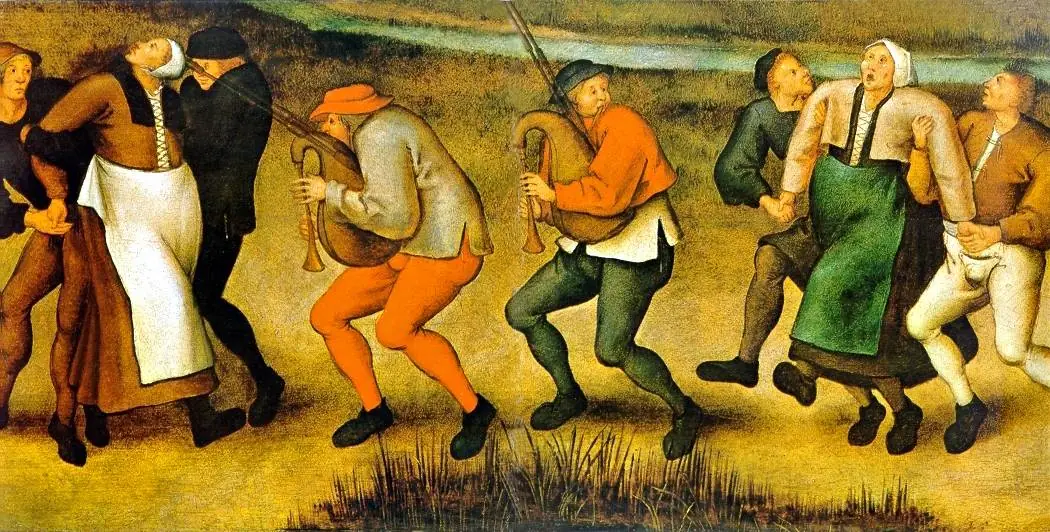
Sources: John Waller, "A forgotten plague: making sense of dancing mania", The Lancet (2009), and "In a spin: the mysterious dancing epidemic of 1518", Endeavour (2008); Encyclopaedia Britannica; "Divine Punishment or Disease? Medieval and Early Modern Approaches to the 1518 Strasbourg Dancing Plague", Dance Research (2017). Cover: "Dance at Molenbeek", Pieter Brueghel the Younger, showing a later pilgrimage of people with dancing mania, public domain.


