Why rain smells so good: the science of petrichor
 Detetive Curioso
··4 min read·Science·126 views
That earthy smell after rain has a name, a molecule and a mechanism. Your nose can detect it at a few parts per trillion.
Almost everyone knows that smell. The first drops of rain hit the dry ground after a hot day and the air fills with a fresh, earthy scent, hard to describe and easy to recognize. For a long time it had no scientific name. Then, in 1964, two Australian researchers gave it one.
Isabel Joy Bear and Richard Thomas worked at CSIRO, Australia’s national science agency. In an article published in the journal Nature, they described how they had distilled a yellowish oil from rocks and clay that had spent a long time dry and in the heat. That oil carried the smell of rain. They called it petrichor, from the Greek petra, stone, and ichor, the golden fluid that was said to run in the veins of the gods in Greek mythology.
Part of that oil comes from plants. During dry periods, some plants release oily compounds that build up on rocks and in the soil. But the real star of the smell was identified a year later, in 1965, by Nancy Gerber and Hubert Lechevalier at Rutgers University. It is a molecule called geosmin, from the Greek for “earth smell”.
Geosmin is made by microbes that live in the soil, mainly bacteria of the genus Streptomyces, and also by some cyanobacteria. It is the same substance that gives beets their earthy taste and that sometimes makes tap water taste of mud. And our noses are incredibly sensitive to it: depending on the study, people can detect geosmin at concentrations of just a few parts per trillion. That is roughly the equivalent of a teaspoon of the substance dissolved in a couple of hundred Olympic swimming pools.
There is still one question left: how does a smell that is stuck in the ground get into the air? The answer arrived in 2015, from MIT. Cullen Buie and Young Soo Joung filmed raindrops hitting different types of soil with high-speed cameras, in hundreds of experiments. They saw that when a drop lands on a porous surface, it traps tiny air bubbles. Those bubbles rise through the drop and burst at the top, shooting out a fine spray of particles, like the fizz from a glass of champagne. Those particles, called aerosols, carry the scent and even microbes from the soil into the air.
The study also explained a detail many people had noticed: light, moderate rain smells stronger than a heavy downpour. Slow drops have time to form more bubbles, while heavy, fast drops flatten out and launch far fewer aerosols. Sandy and clay soils, which are common after long dry spells, produce the most. The same rain that releases the smell also wakes up other tiny residents: when dry moss gets wet, the tardigrades that were “switched off” inside it start walking again.
And the sharp, clean smell that sometimes arrives before a storm is something else entirely. That one is usually ozone, a gas produced when lightning splits oxygen and nitrogen molecules in the air. Wind from the storm carries it down to ground level.
Why are we so good at smelling geosmin? No one knows for sure. One popular idea is that it helped our ancestors find water. Other animals use it too: tiny insects called springtails are attracted to geosmin and, in return, help spread the bacteria’s spores. Whatever the reason, the next time it rains on dry ground, you will know that you are smelling a mix of plant oils, bacteria and microscopic bubbles. It still smells wonderful. Not every planet is so lucky: Uranus smells like rotten eggs.
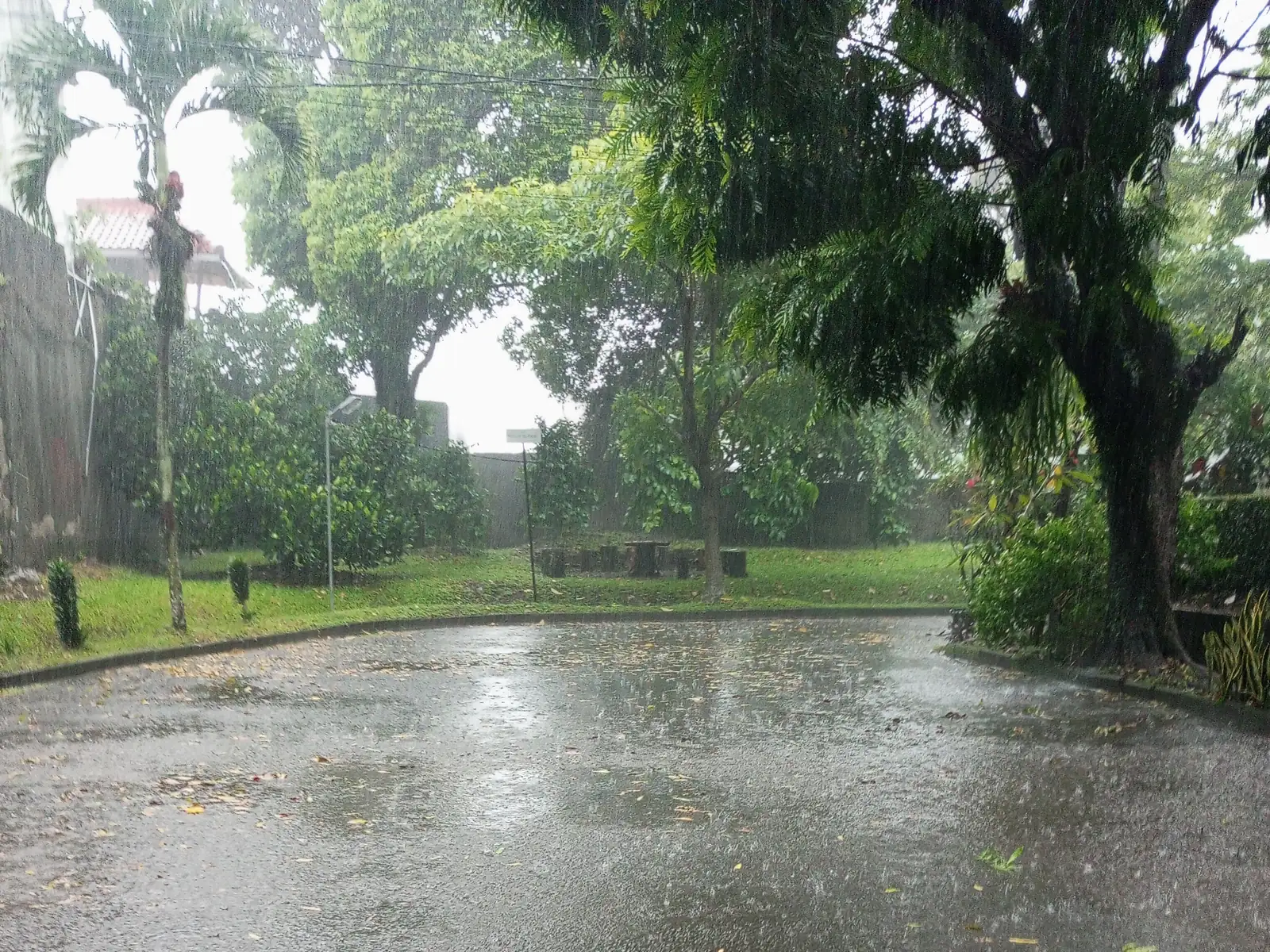
Sources: Bear & Thomas, Nature (1964), Gerber & Lechevalier, Applied Microbiology (1965), Joung & Buie, Nature Communications (2015), MIT News, Chemical & Engineering News, Becher et al., Nature Microbiology (2020). Cover: rain on a street, by Yuna Izmaya, Wikimedia Commons, CC BY-SA 4.0.