Tardigrades: the half-millimeter animals that survived the vacuum of space
 Detetive Curioso
··4 min read·Science·108 views
They live in the moss on your wall, can go years without water and came back alive from 10 days in open space. Meet the toughest animals on Earth.
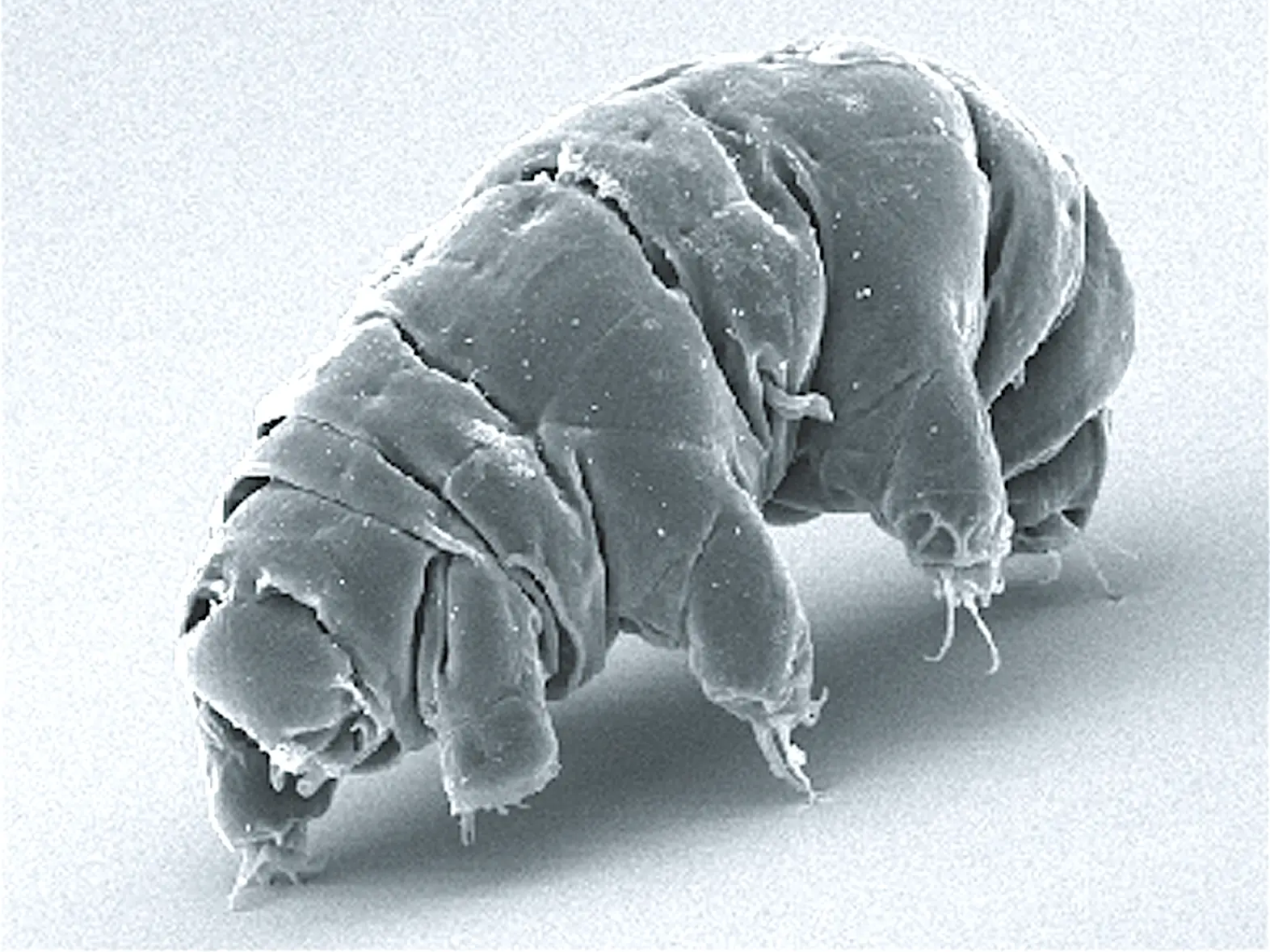
There is a good chance that a creature able to survive in outer space is living a few meters from you right now. Pick up a clump of damp moss from a wall or a tree, soak it in water and look at it under a simple microscope. Sooner or later you will see a chubby, translucent animal with eight stubby legs, walking slowly like a tiny bear. That is a tardigrade.
They were first described in 1773 by the German pastor Johann August Ephraim Goeze, who called them “kleiner Wasserbär”, little water bear. Three years later, the Italian scientist Lazzaro Spallanzani gave them the name Tardigrada, “slow walkers”. Today more than 1,300 species are known, living everywhere from the Himalayas to the deep sea. Most are smaller than half a millimeter; the biggest barely pass one millimeter.
Their superpower is called anhydrobiosis, life without water. When their environment dries out, tardigrades pull in their legs and head, lose almost all the water in their bodies and shrink into a dry little barrel known as a “tun”. In that state their metabolism becomes almost undetectable. They can stay like this for years, and when water comes back, they rehydrate and simply walk away.
In the tun state, laboratory tests have shown tardigrades surviving temperatures close to absolute zero, at about −272 °C, and brief exposures to heat near or even above the boiling point of water. They have endured pressures of 7.5 gigapascals, about 75,000 times the pressure of the air around us, and doses of radiation hundreds of times higher than what would kill a human.
In September 2007, the European Space Agency decided to test the ultimate limit. In the TARDIS experiment, dried tardigrades flew on the Russian FOTON-M3 capsule and spent about ten days exposed to open space, at an altitude of roughly 260 to 280 kilometers. The results, published in Current Biology in 2008 by a team led by K. Ingemar Jönsson, were stunning: the vacuum and the cold of space alone did not hurt their survival. What did hurt was the Sun’s full ultraviolet light. In the group exposed to everything, only a handful survived, but that was enough to make them the first animals known to survive direct exposure to space.
Part of the secret was found in 2016, when Japanese researchers led by Takekazu Kunieda and Takuma Hashimoto sequenced the genome of the species Ramazzottius varieornatus. They discovered a protein unique to tardigrades and named it Dsup, for “damage suppressor”. It seems to wrap around DNA like a shield. When the scientists inserted the gene into human cells grown in the lab, those cells suffered about 40% less DNA damage from X-rays. Researchers are now studying whether ideas like this could someday help protect astronauts or preserve vaccines without refrigeration.
Tardigrades have even been to the Moon, although not by choice. In April 2019, the Israeli lander Beresheet crashed onto the lunar surface carrying thousands of dried tardigrades in a small archive. A 2021 study fired tardigrades from a gas gun to recreate the impact and concluded that they almost certainly did not survive the crash. Still, the Moon is next door: the most distant human-made object, Voyager 1, is about one light-day from Earth.
One last surprise: tardigrades are not immortal. Active ones live from a few months to a couple of years, and they are much more fragile when they are awake. Their real talent is not invincibility, but knowing how to pause life and wait for better days.
Sources: European Space Agency (TARDIS experiment), Jönsson et al., Current Biology (2008), Hashimoto et al., Nature Communications (2016), Traspas & Burchell, Astrobiology (2021). Cover: Milnesium tardigradum under a scanning electron microscope, Schokraie et al., PLoS ONE (2012), CC BY 2.5.