Sharks are older than trees, and they have survived five mass extinctions
 Detetive Curioso
·4 min read·Science·9 views
The first shark-like animals were swimming about 450 million years ago. The first trees only appeared some 385 million years ago. Here is how sharks got such a head start.
Sharks are older than trees. It sounds like one of those internet facts that falls apart when you check it, but this one holds up. The oldest remains that may belong to sharks are about 450 million years old. The oldest known trees are about 385 million years old. For tens of millions of years, there were sharks in the sea and not a single tree on land.
The evidence for the earliest sharks is tiny. Shark skeletons are made of cartilage, not bone, and cartilage rarely fossilizes. What survives are teeth, spines and the small, tooth-like scales that cover their skin, called denticles. According to the Natural History Museum in London, the oldest candidates are a handful of scales from the Late Ordovician period, about 450 million years ago. Not everyone agrees that they came from true sharks, and no teeth have been found with them. But scales that are accepted as shark scales appear around 420 million years ago, and teeth soon after.
The oldest shark preserved in one piece is a little younger. In 2003, paleontologists described a fossil from New Brunswick, in Canada, of a species called Doliodus problematicus. It is almost 409 million years old, and it still has its teeth, part of its braincase and a pair of spines in front of its fins.
Now the trees. During most of that time, life on land was low to the ground: mosses, liverworts and small plants without leaves or roots worth mentioning. The first real forests appeared in the Middle Devonian period. In 2007, a team led by William Stein published the reconstruction of Wattieza, a tree-like plant up to 8 meters tall that grew in what is now New York State about 385 million years ago. In 2020, the same researchers described an even older fossil forest in a quarry in Cairo, New York, with roots of the tree Archaeopteris, dated to about 386 million years. Those are the oldest forests known.
So when the first trees rose, sharks had already been around for something like 35 to 65 million years, depending on which fossils you accept. And they kept going. Sharks are older than dinosaurs, which appeared about 230 million years ago, and much older than flowers, grass or mammals. The Natural History Museum notes that they survived all five of the great mass extinctions, including the asteroid that wiped out the large dinosaurs 66 million years ago. Tardigrades are famous for surviving almost anything, but as a family, sharks may be the champions of endurance.
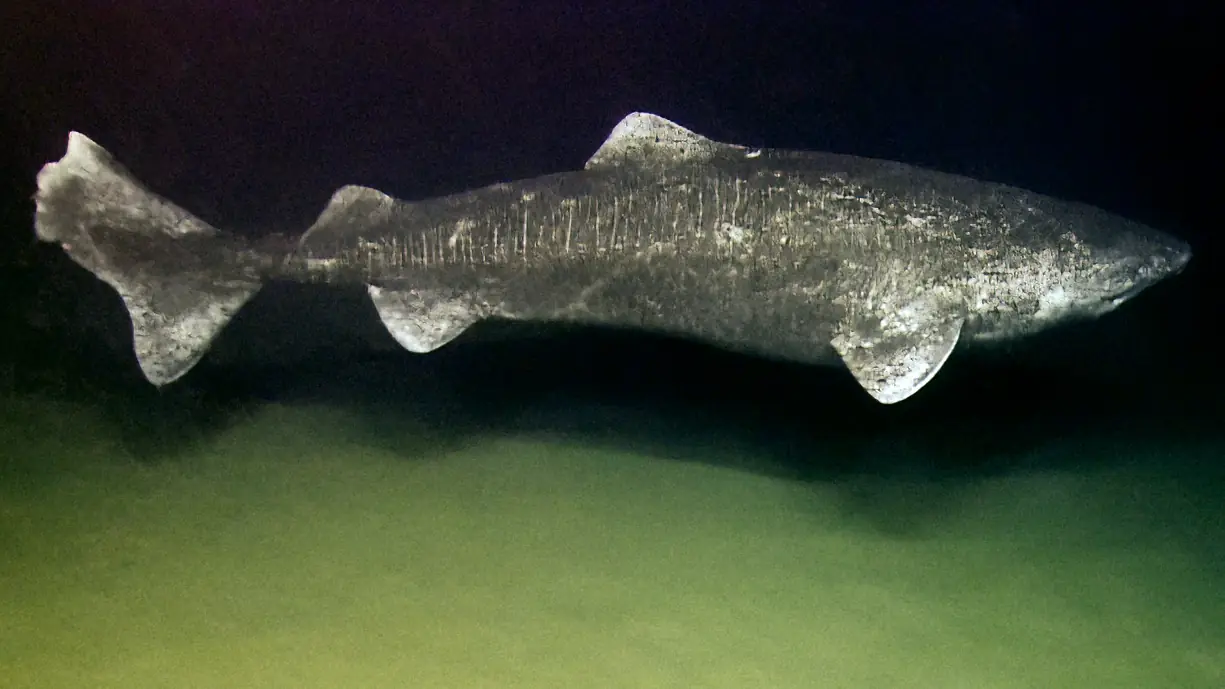
Some individual sharks also live absurdly long. In 2016, a team led by Julius Nielsen, of the University of Copenhagen, used radiocarbon dating on the eye lenses of 28 Greenland sharks, the slow giants of the Arctic. The largest, just over 5 meters long, was estimated to be 392 years old, give or take 120 years. That makes the Greenland shark the longest-lived vertebrate known. The study also suggested that females only reach maturity at around 150 years of age.
None of this makes sharks invincible. Many species are now threatened by overfishing, and they reproduce slowly. After 450 million years in the oceans, the biggest danger they have ever faced may be us.
Sources: Natural History Museum (London); Miller, Cloutier & Turner, Nature (2003); Stein et al., Nature (2007); Stein et al., Current Biology (2020); Nielsen et al., Science (2016). Cover: Greenland shark (Somniosus microcephalus), NOAA Okeanos Explorer Program, Wikimedia Commons, public domain.