大富翁其实是一位女性发明的,用来揭示地主有多不公平
 Detetive Curioso
··4 分钟阅读·流行文化·112 次浏览
早在帕克兄弟公司之前,莉齐·马吉就在1904年为“地主游戏”申请了专利,用来警示垄断的危害。她只得到500美元,随后被人遗忘。
本文尚未翻译。
For decades, the box told a tidy story. In the middle of the Great Depression, an unemployed salesman from Philadelphia named Charles Darrow invented a board game at his kitchen table, sold it to Parker Brothers in 1935 and became rich. It was a perfect American tale. It just was not true.
The game was born thirty years earlier, in the head of Elizabeth “Lizzie” Magie, from Brentwood, Maryland. Magie was not a typical woman of her time. She worked as a stenographer, wrote poems and short stories, acted on stage, and in 1893 had already patented a device to make typewriters easier to use. She was also a passionate follower of the economist Henry George, who argued that land should be taxed so that a few landlords could not get rich just by owning it.
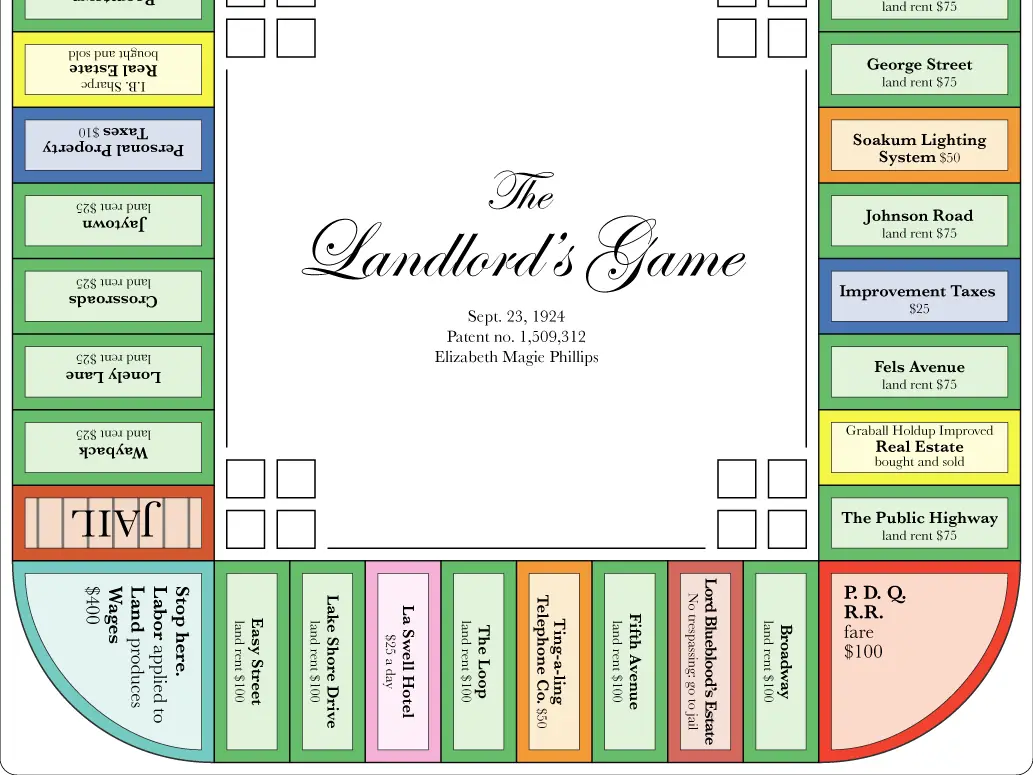
To explain those ideas, she created a game. On March 23, 1903, she filed a patent for The Landlord’s Game, granted on January 5, 1904, as U.S. patent 748,626. The board will look familiar to anyone who has played Monopoly: a square track with properties, railroads, utilities and four corners. One corner said “Labor Upon Mother Earth Produces Wages”, where players collected money. Another was the Poor House. And there was a corner owned by the fictional Lord Blueblood, with a sign: “No Trespassing — Go to Jail”.
The goal was educational. Players would discover, the hard way, how one person accumulating land and rent could ruin everyone else. Magie later described two sets of rules: one where everyone was rewarded when wealth was created, and a monopolist version where the aim was to crush your opponents. Guess which one became popular.
In 1909, Magie offered the game to Parker Brothers, who turned it down as too complicated. But The Landlord’s Game took on a life of its own. It spread among university students, in Quaker communities and in towns across the northeast of the United States. People made their own boards by hand, changed the rules and renamed the streets after their own neighborhoods. In Atlantic City, New Jersey, players used local street names, including Boardwalk, Park Place and Marven Gardens, which a later copy misspelled as “Marvin Gardens”.
That is the version Charles Darrow learned from friends around 1932. He copied the board almost exactly, mistakes included, added some illustrations, and started selling it. In 1935, Parker Brothers bought the rights and Darrow received his own patent in December of that year. He became the first board game designer to make a million dollars.
To protect itself, Parker Brothers also bought Magie’s updated 1924 patent. She received $500 and no royalties. She talked to reporters about the injustice, but the official story stuck for decades, and she died in 1948 without credit for her game.
The truth only came back in the 1970s, almost by accident. An economics professor named Ralph Anspach created a game called Anti-Monopoly and was sued by the company. While preparing his defense, he dug into old archives and found Lizzie Magie’s patents. More recently, journalist Mary Pilon told the whole story in her book The Monopolists. Today, Monopoly is one of the best-selling board games in history, and most of the people who play it are, without knowing it, acting out exactly the lesson its inventor wanted to warn us about. And it is not the only invention that ended up far from its original purpose: Bubble Wrap was meant to be wallpaper.
Sources: Smithsonian Lemelson Center for the Study of Invention and Innovation, HISTORY, Mary Pilon, The Monopolists (2015), U.S. Patent 748,626. Cover: The Landlord’s Game board based on the 1924 patent, by Lucius Kwok, CC BY 2.5.


