The 1755 Lisbon Earthquake Struck on All Saints' Day and Gave Birth to Modern Seismology
 Detetive Curioso

·4 min read·History·0 views
On 1 November 1755 an earthquake, a tsunami and fires wiped out most of Lisbon. The survey Portugal ran afterwards helped launch modern seismology.
At around 9:40 on the morning of 1 November 1755, All Saints' Day, a massive earthquake struck Lisbon. Within hours, the shaking, a tsunami and days of fire had destroyed most of the capital of one of Europe's richest empires, and economic historian Álvaro Pereira estimates that 30,000 to 40,000 of its roughly 200,000 residents died.
The disaster also wrecked the economy. In a 2009 study in the Journal of Economic History, Pereira calculated that the direct losses equaled 32 to 48 percent of Portugal's entire GDP, which makes it the largest natural catastrophe ever recorded in Europe.
According to Lisbon's Quake museum, the sea came next. Between 60 and 90 minutes after the shock, waves about 5 meters high rushed up the Tagus River and flooded the waterfront. Waves of 10 to 15 meters hit the Sagres area, more than 10 meters reached Cádiz in Spain, and the tsunami crossed the Atlantic, with waves of about 3 meters reported in the Caribbean. Meanwhile, fires started by kitchen stoves and the candles lit in churches for the holiday spread through the ruins.
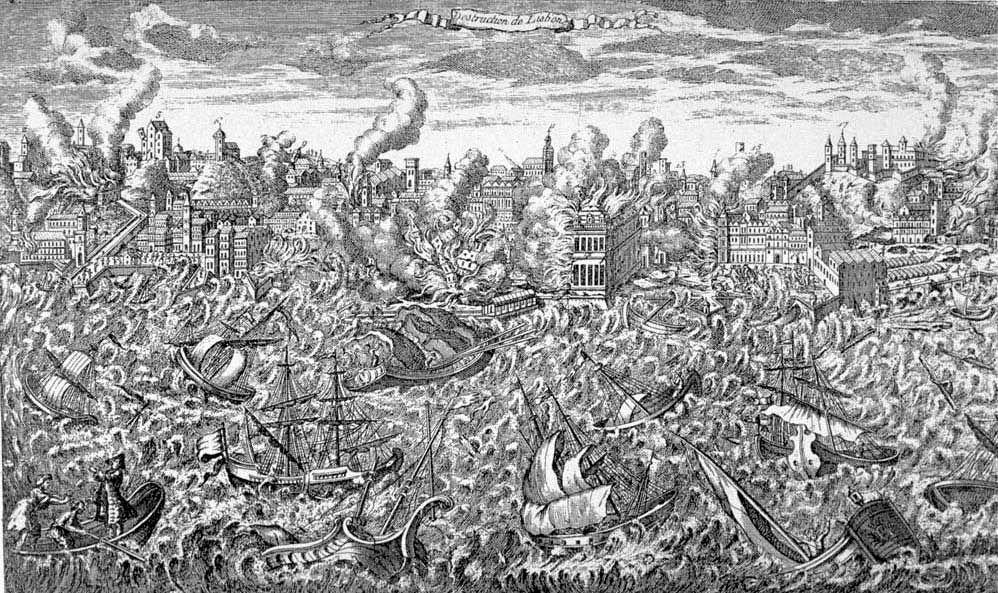
How strong was it? In 1949, seismologists Beno Gutenberg and Charles Richter suggested a magnitude between 8.75 and 9, and later estimates landed at 8.5 to 8.7. In 2020, João Fonseca of the University of Lisbon reworked 1,206 historical reports from Portugal, Spain and Morocco and arrived at a moment magnitude of 7.7, give or take 0.5, as he explained in the Bulletin of the Seismological Society of America. Its exact offshore source, southwest of Iberia, is still uncertain.
Much of what we know comes from a questionnaire. In January 1756, the king's minister Sebastião José de Carvalho e Melo, later the Marquis of Pombal, had bishops send 13 questions to every parish priest in the kingdom. They asked when the shaking began and how long it lasted, from which direction it seemed to come, how many houses fell, who died, what the sea did first, whether the ground cracked and how long fires burned. The Quake museum notes that thousands of answers survive in the Torre do Tombo national archive, and a study in the journal Cultura describes the survey as a founding act of modern seismology.
Military engineers Manuel da Maia, Eugénio dos Santos and Carlos Mardel drew a downtown of straight, wide streets, and the new buildings received the gaiola pombalina, or Pombaline cage. It is a three dimensional wooden frame braced with diagonal crosses and hidden inside the masonry walls above the ground floor. A paper presented at the 13th World Conference on Earthquake Engineering found that, in a computer model, the cage cut a wall's sideways movement by about 70 percent.

A popular story says soldiers marched around full scale models in the Terreiro do Paço square to test them. Engineering professors at Lisbon's Instituto Superior Técnico say these accounts are hard to confirm, but if true, it would be the first shaking table on record.
The quake also shook European thought. Voltaire wrote his Poem on the Lisbon Disaster in 1756 and mocked blind optimism in Candide in 1759, while a young Immanuel Kant tried to explain earthquakes through natural causes rather than divine anger. In Lisbon, the roofless arches of the Carmo Convent were left standing as a reminder.
Sources: Fonseca, Bulletin of the Seismological Society of America (2020); Pereira, Journal of Economic History (2009); Quake Lisbon Earthquake Center: history and the inquiry; Cultura (2016); 13th World Conference on Earthquake Engineering (2004); Instituto Superior Técnico. Cover: Carmo Convent ruins in Lisbon.


